How to Size a Solar Generator – Step‑by‑Step Load & Runtime Guide
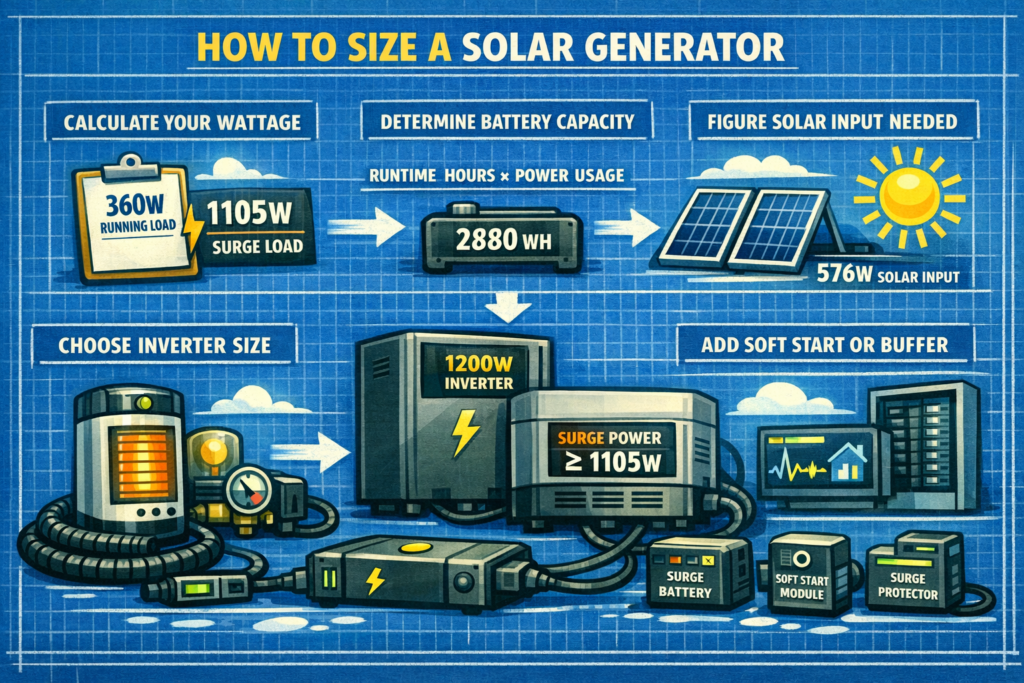
Sizing a solar generator is simple once you break it into three numbers: wattage (W), energy (Wh), and solar input (W of panels). Get those right, and you’ll know exactly how long you can run your devices and how quickly you can recharge from the sun.
This guide walks you through a step‑by‑step process to size a solar generator for camping, RV use, home backup, or off‑grid cabins.
Step 1 – List Your Devices and Wattage
Start by listing everything you want to run from your solar generator. Use device labels, manuals, or a plug‑in power meter to find real‑world wattage.
| Device | Typical Watts | Hours per Day |
|---|---|---|
| LED lights (x4) | 40W | 5 hours |
| Laptop | 60W | 4 hours |
| Wi‑Fi router | 15W | 8 hours |
| Mini fridge | 60W (average) | 24 hours (cycling) |
| Phone charging (x2) | 20W | 2 hours |
For more accuracy, use a plug‑in meter like the Kill A Watt to measure actual draw.
Step 2 – Convert to Daily Energy Use (Watt‑Hours)
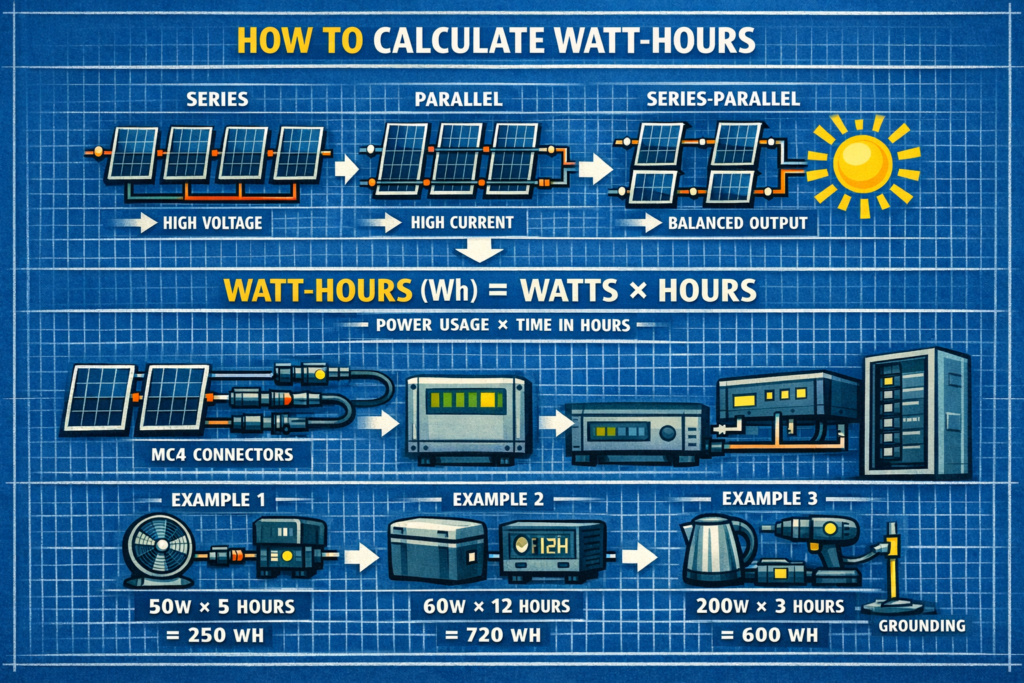
Multiply watts by hours to get daily watt‑hours (Wh) for each device, then total them.
| Device | Watts | Hours | Daily Wh |
|---|---|---|---|
| LED lights | 40W | 5h | 200Wh |
| Laptop | 60W | 4h | 240Wh |
| Wi‑Fi router | 15W | 8h | 120Wh |
| Mini fridge | 60W | 24h (cycling) | 1440Wh |
| Phone charging | 20W | 2h | 40Wh |
| Total Daily Energy | 2040Wh | ||
In this example, you need about 2000Wh per day to cover your loads.
Step 3 – Choose Battery Capacity (Wh)
As a rule of thumb, choose a solar generator with at least 1.5–2× your daily energy use so you’re not draining it to zero every day.
| Daily Use | Minimum Battery Size | Comfortable Battery Size |
|---|---|---|
| 500Wh/day | 500–800Wh | 1000–1500Wh |
| 1000Wh/day | 1000–1500Wh | 1500–2000Wh |
| 2000Wh/day | 2000–2500Wh | 2500–3000Wh |
| 3000Wh/day | 3000–4000Wh | 4000–5000Wh |
For our 2040Wh/day example, a 2000–3000Wh solar generator is ideal.
Step 4 – Check Inverter Size (Watts)
Your solar generator’s inverter must handle the peak watts of everything running at once, plus any startup surges (fridges, pumps, tools).
| Use Case | Typical Peak Load | Recommended Inverter |
|---|---|---|
| Basic camping | 100–300W | 500–800W inverter |
| Fridge + lights + devices | 300–800W | 1000–1500W inverter |
| Power tools / small AC | 800–1500W | 2000–3000W inverter |
| Heavy loads (heaters, pumps) | 1500–2500W+ | 3000W+ inverter |
Always choose a pure sine wave inverter for electronics, fridges, and motors.
Step 5 – Size Your Solar Panels (Recharge Rate)
Next, size your solar array so you can recharge your battery in a reasonable time. Use this simple formula:
Solar Watts ≈ Battery Wh ÷ Sun Hours ÷ 1.2 (loss factor)
Example: 2000Wh battery, 5 sun hours:
2000Wh ÷ 5 ÷ 1.2 ≈ 333W of solar
| Battery Size | Sun Hours | Recommended Solar Input |
|---|---|---|
| 1000Wh | 4–5h | 200–300W |
| 2000Wh | 4–5h | 300–400W |
| 3000Wh | 4–5h | 400–600W |
| 5000Wh | 4–5h | 800–1200W |
Example Solar Generator Sizes by Use Case
Small Solar Generator (500–1000Wh)
Good for lights, phones, cameras, and a laptop.
| Battery | 500–1000Wh |
|---|---|
| Inverter | 500–1000W |
| Solar | 100–200W |
Example: Jackery 1000–1500 class
Medium Solar Generator (1500–3000Wh)
Good for fridge, lights, router, and devices.
| Battery | 1500–3000Wh |
|---|---|
| Inverter | 1500–3000W |
| Solar | 300–600W |
Example: EcoFlow DELTA Pro or similar class.
Large Solar Generator (3000–5000Wh+)
Good for fridge, lights, tools, and occasional AC.
| Battery | 3000–5000Wh+ |
|---|---|
| Inverter | 3000–5000W |
| Solar | 800–1200W |
Example: BLUETTI AC500 class
Common Mistakes When Sizing a Solar Generator
- Only looking at watts: Inverter watts matter, but watt‑hours determine runtime.
- Ignoring solar input: A big battery with tiny solar input takes days to recharge.
- Underestimating fridge loads: They cycle, but run many hours per day.
- Forgetting surge: Compressors and tools can spike 2–3× their running watts.
- No buffer: Running at 90–100% capacity every day shortens battery life.
FAQ: How to Size a Solar Generator
What size solar generator do I need for a fridge
Most fridges need 60–150W running and 600–1200W surge. A 1000–2000Wh solar generator with a 1000–1500W inverter and 200–400W of solar is a good starting point.
How long will a 1000Wh solar generator last
Divide 1000Wh by your load. For a 100W load, expect roughly 8–9 hours after inverter losses.
How much solar do I need for a 2000Wh battery
For 4–5 sun hours, 300–400W of solar will recharge a 2000Wh battery in a day under good conditions.
Can I run a space heater on a solar generator
Technically yes, but 1000–1500W heaters drain batteries very quickly. It’s usually not practical unless you have a very large system.
🔆 Explore More Solar & Backup Power Guides
Dial in your solar generator, panels, and battery bank with our full collection of sizing and runtime guides.
As an Amazon Associate, we earn from qualifying purchases. This does not affect our reviews or product recommendations.