How to Run Appliances on Solar – Practical Sizing & Setup Guide
Running appliances on solar is completely doable—if you size your battery, inverter, and solar panels correctly. The trick is to stop guessing and start working with watts, watt‑hours, and solar input.
This guide walks through how to run common appliances (fridges, TVs, routers, fans, and more) on solar using a solar generator or a battery + inverter + panel setup.
Step 1 – Know Your Appliance Wattage
Every appliance has a watt rating (W). Some also have a surge or starting wattage, especially those with compressors or motors.
| Appliance | Typical Running Watts | Notes |
|---|---|---|
| LED TV (40–55″) | 60–120W | Steady draw |
| Wi‑Fi router | 10–20W | Always on |
| Laptop | 40–80W | Varies with use |
| Mini fridge | 50–100W (avg) | Cycles on/off, 3–8× surge |
| Full‑size fridge | 100–200W (avg) | Cycles, 3–8× surge |
| Box fan | 40–80W | Steady draw |
Use labels, manuals, or a plug‑in meter to get real numbers.
Step 2 – Convert to Daily Watt‑Hours
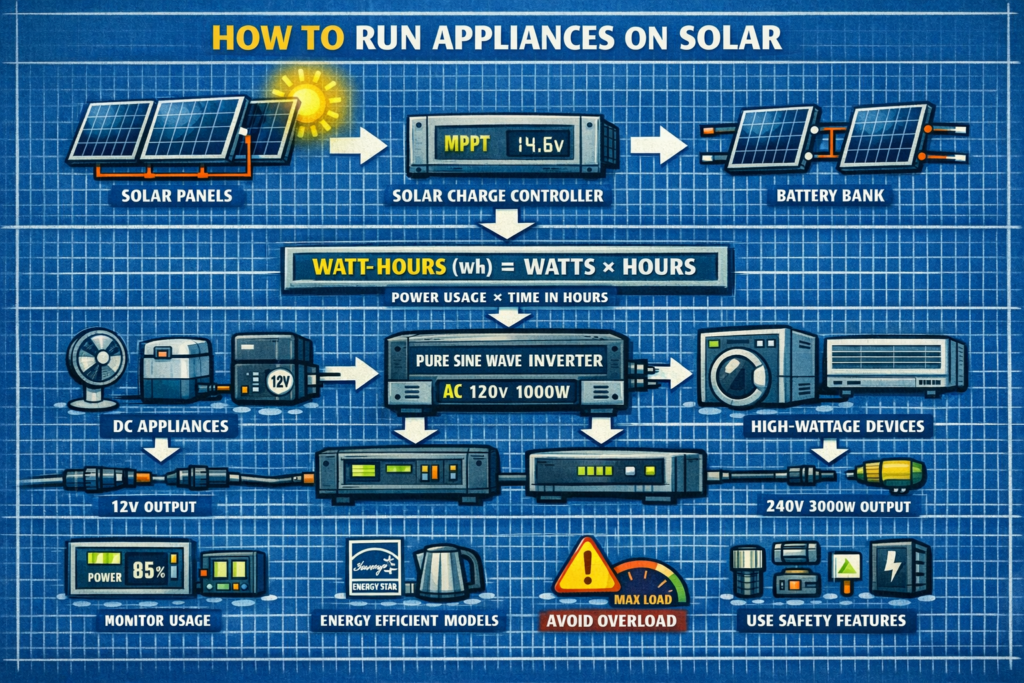
To run appliances on solar, you must know how much energy per day they use. That’s watt‑hours (Wh):
Watt‑hours (Wh) = Watts (W) × Hours (h)
| Appliance | Watts | Hours per Day | Daily Wh |
|---|---|---|---|
| LED TV | 80W | 3h | 240Wh |
| Laptop | 60W | 4h | 240Wh |
| Router | 15W | 12h | 180Wh |
| Mini fridge | 60W (avg) | 24h (cycling) | 1440Wh |
| Total Daily Energy | 2100Wh | ||
In this example, you need about 2100Wh per day to run these appliances.
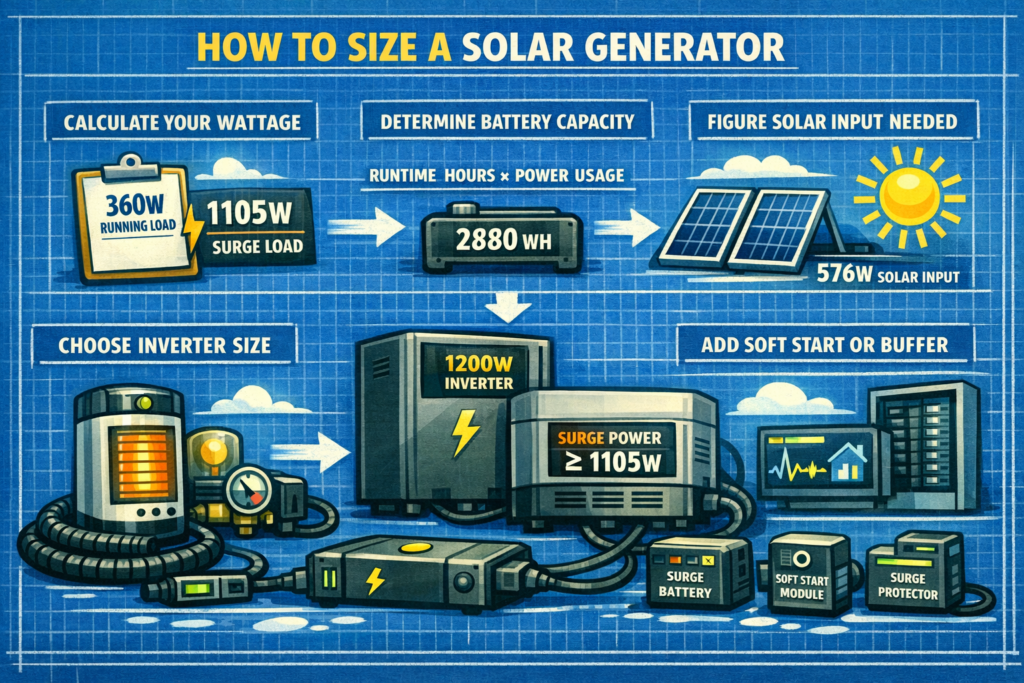
Step 3 – Size Your Battery or Solar Generator
To run appliances reliably, size your battery at least 1.5–2× your daily watt‑hours so you’re not draining it to zero every day.
| Daily Load | Minimum Battery Size | Comfortable Battery Size |
|---|---|---|
| 500Wh/day | 500–800Wh | 800–1200Wh |
| 1000Wh/day | 1000–1500Wh | 1500–2000Wh |
| 2000Wh/day | 2000–2500Wh | 2500–3000Wh |
| 3000Wh/day | 3000–4000Wh | 4000–5000Wh |
For our 2100Wh/day example, a 2500–3000Wh solar generator or battery bank is ideal.
Step 4 – Check Inverter Size for Appliance Startup
Appliances with motors or compressors (fridges, pumps, AC units) need extra power to start. This is surge wattage.
| Appliance | Running Watts | Estimated Surge | Recommended Inverter |
|---|---|---|---|
| Mini fridge | 60–100W | 300–600W | ≥ 600–800W |
| Full‑size fridge | 100–200W | 600–1200W | ≥ 1000–1500W |
| Small window AC | 500–800W | 1500–2500W | ≥ 2000–3000W |
Always use a pure sine wave inverter for fridges, electronics, and anything with a motor.
Step 5 – Size Your Solar Panels (Recharge from the Sun)
To keep appliances running day after day, your solar panels must replace what you use.
Solar Watts ≈ Daily Wh ÷ Sun Hours ÷ 1.2
Example: 2100Wh/day, 5 sun hours:
2100Wh ÷ 5 ÷ 1.2 ≈ 350W of solar
| Daily Load | Sun Hours | Recommended Solar |
|---|---|---|
| 1000Wh/day | 4–5h | 200–300W |
| 2000Wh/day | 4–5h | 300–400W |
| 3000Wh/day | 4–5h | 500–800W |
Can You Run These Appliances on Solar?
Running a Fridge on Solar
A typical full‑size fridge uses 100–200W running and 1000–2000Wh per day.
| Battery | 2000–3000Wh |
|---|---|
| Inverter | 1000–1500W (good surge) |
| Solar | 300–500W |
Yes, you can run a fridge on solar—if you size for daily energy, not just watts.
Running TV, Router, and Laptop on Solar
These are low‑to‑moderate loads and very solar‑friendly.
| Battery | 500–1500Wh |
|---|---|
| Inverter | 300–800W |
| Solar | 100–300W |
Perfect for small solar generators and weekend setups.
Running Heaters or AC on Solar
Electric heaters and AC units are extremely power‑hungry.
| Space heater | 1000–1500W |
|---|---|
| Small AC | 500–800W |
| Reality | Drains batteries fast |
Short‑term use is possible on large systems, but not ideal for all‑day solar operation.
Direct Solar vs Battery‑Backed Solar
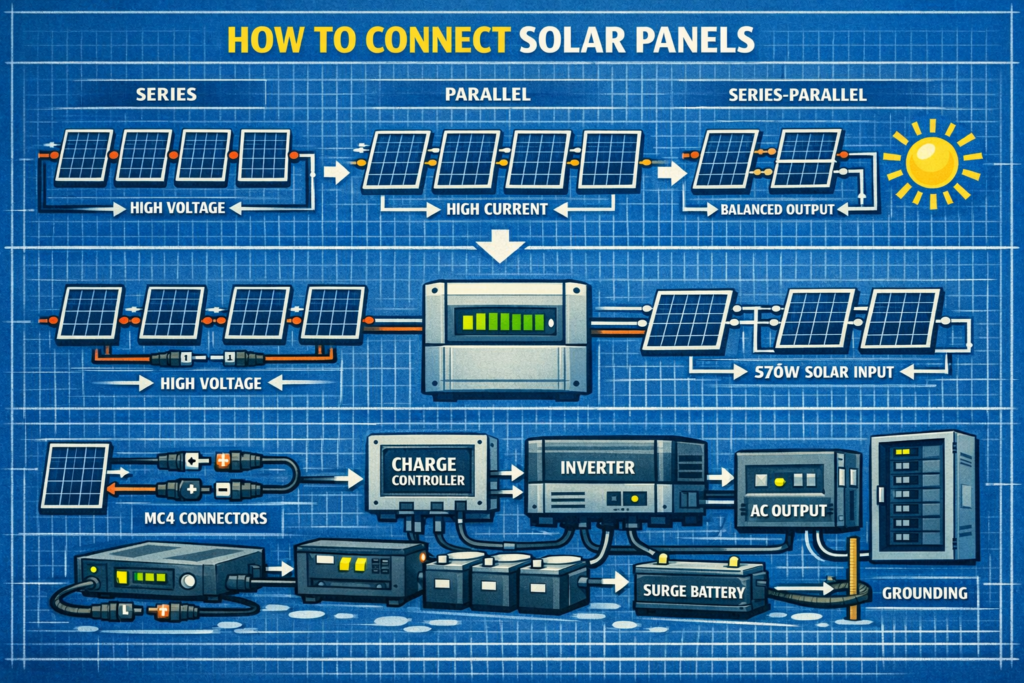
You don’t run appliances directly from panels—you run them from a battery and inverter that is recharged by solar.
- Panels → Charge Controller → Battery → Inverter → Appliances
- Or: Panels → Solar Generator → Appliances
Panels provide energy over time. Batteries provide instant power and runtime.
Common Mistakes When Running Appliances on Solar
- Only looking at watts: ignoring daily watt‑hours and runtime
- Under‑sizing solar: big battery, tiny panel array
- Ignoring surge: fridges and pumps tripping inverters
- Expecting electric heat: heaters eat batteries alive
- No load prioritization: trying to run “the whole house” on a small system
FAQ: Running Appliances on Solar
Can I run my whole house on solar and batteries
Yes, but it requires a large system (10–30kWh+ battery, kW‑scale solar, and a whole‑home inverter).
Can I run a fridge and TV on a solar generator
Yes—look for 1000–2000Wh+ capacity, 1000–1500W inverter, and 300–400W of solar.
How long will a 1000Wh battery run a 100W appliance
Roughly 8–9 hours after inverter losses.
Is solar good for emergency backup
Yes—especially for fridges, lights, routers, and device charging. It shines for essentials.
🔆 Explore More Solar & Appliance Guides
Dial in your solar generator, panels, and appliance runtimes with our full collection of guides.
As an Amazon Associate, we earn from qualifying purchases. This does not affect our reviews or product recommendations.