How to Connect Solar Panels to a Charge Controller (MPPT vs PWM)
Connecting solar panels to a charge controller is simple once you understand voltage, wiring, and the difference between MPPT and PWM controllers. The wiring order matters, the voltage limits matter, and the controller type determines whether you should wire panels in series or parallel.
This guide gives you a clean, step‑by‑step method for connecting solar panels to MPPT and PWM controllers safely and efficiently.
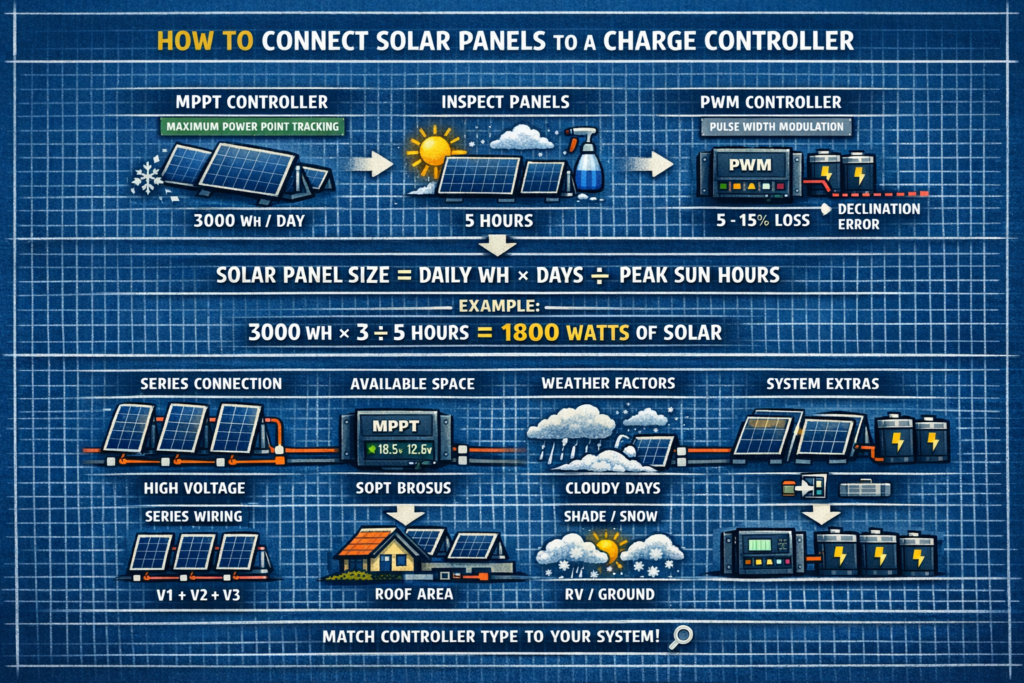
MPPT vs PWM: What’s the Difference?
| Feature | MPPT Controller | PWM Controller |
|---|---|---|
| Efficiency | 95–99% | 70–80% |
| Best Wiring | Series or series‑parallel | Parallel only |
| Panel Voltage | Can be higher than battery voltage | Must match battery voltage |
| Cost | Higher | Lower |
| Best For | Large arrays, cold climates, long wire runs | Small systems, budget builds |
Rule of thumb: If you have more than 200W of solar, MPPT is almost always the better choice.
Correct Connection Order (Very Important)
Charge controllers must be connected in the correct order to avoid damage.
- Connect battery → charge controller
- Connect solar panels → charge controller
- Connect load (optional)
Never connect solar panels to the controller before the battery. The controller needs battery voltage to boot safely.
How to Connect Solar Panels to an MPPT Charge Controller
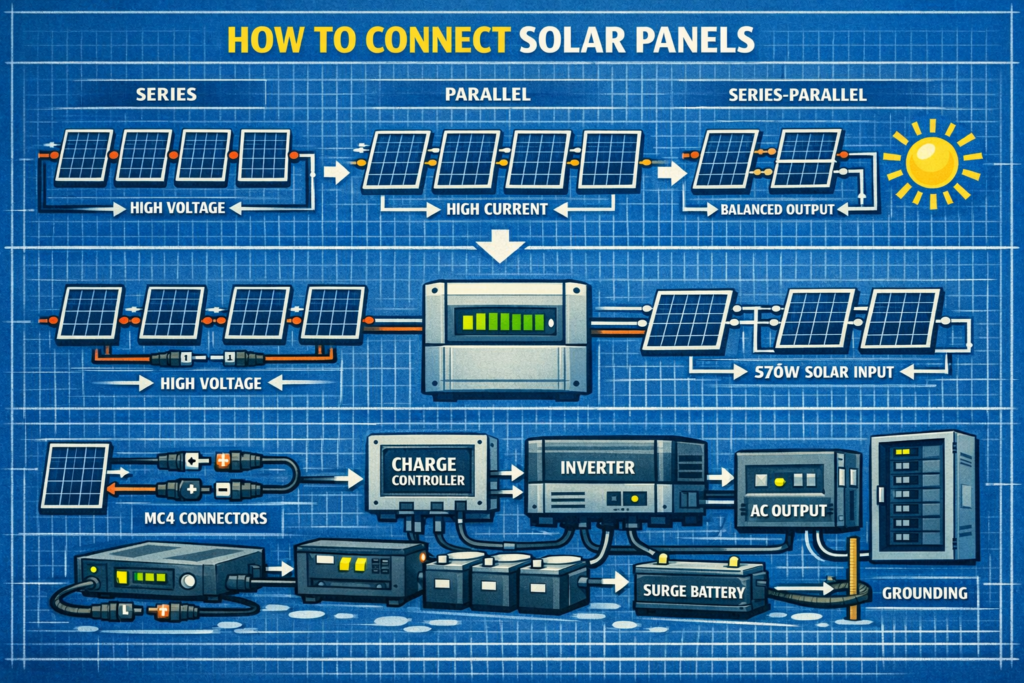
MPPT controllers convert excess panel voltage into usable charging current. This means you can wire panels in series for higher voltage and lower current (less loss).
Steps:
- Connect battery to the MPPT controller (battery terminals)
- Wire solar panels in series or series‑parallel
- Connect the panel positive (+) and negative (–) to the MPPT PV input
- Confirm voltage is within the controller’s PV input range
- Check the controller display for charging watts
Series Example:
| Panels | Result |
|---|---|
| 2 × 100W (18V, 5.5A) | 36V, 5.5A |
| 4 × 100W | 72V, 5.5A |
Why MPPT loves series: Higher voltage stays above the battery voltage even in low light, improving winter and cloudy‑day performance.
How to Connect Solar Panels to a PWM Charge Controller
PWM controllers simply “pulse” the panel voltage down to battery voltage. This means panel voltage must match the battery voltage, so parallel wiring is required.
Steps:
- Connect battery to the PWM controller
- Wire solar panels in parallel using MC4 Y‑branch connectors
- Connect the combined positive and negative to the PWM PV input
- Ensure panel voltage matches battery voltage (12V panels for 12V batteries)
- Check the controller for charging amps
Parallel Example:
| Panels | Result |
|---|---|
| 2 × 100W (18V, 5.5A) | 18V, 11A |
| 4 × 100W | 18V, 22A |
Why PWM requires parallel: It cannot step down high voltage like MPPT can.
Series vs Parallel for Charge Controllers
| Wiring Type | Voltage | Amperage | Best For |
|---|---|---|---|
| Series | Increases | Same | MPPT controllers, long wire runs, winter |
| Parallel | Same | Increases | PWM controllers, low‑voltage solar generators |
How to Check Voltage Before Connecting
Use a multimeter to confirm:
- Open‑circuit voltage (Voc) of your panel string
- It must be below the controller’s max PV voltage
Cold weather increases Voc, so leave 10–20% safety margin.
Full Connection Diagram (Text Version)
MPPT Setup:
- Panels (series) → PV input on MPPT
- Battery → Battery terminals on MPPT
- Inverter (optional) → Battery
PWM Setup:
- Panels (parallel) → PV input on PWM
- Battery → Battery terminals on PWM
- Inverter (optional) → Battery
Common Mistakes When Connecting Panels to Controllers
- Connecting solar before the battery (can fry the controller)
- Exceeding PV voltage on MPPT inputs
- Using series wiring on PWM (won’t charge properly)
- Mismatched panels in series (voltage mismatch wastes power)
- Undersized wire causing voltage drop
FAQ: Connecting Solar Panels to Charge Controllers
Can I mix different solar panels?
Only if voltage and current match closely. Otherwise, the array will down‑rate to the weakest panel.
Can I use MPPT with low‑voltage solar generators?
Yes, but only if the generator supports external MPPT charging.
Do I need fuses?
Yes—parallel strings should be fused to prevent back‑feeding.
Can I connect an inverter to the charge controller?
No—connect the inverter directly to the battery, not the controller.
🔆 Explore More Solar Wiring Guides
Pair your charge controller with the right wiring, angles, and panel sizing for maximum efficiency.
As an Amazon Associate, we earn from qualifying purchases. This does not affect our reviews or product recommendations.