How to Choose Solar Panel Angles – Seasonal & Latitude Guide
Choosing the right solar panel angle can increase your energy production by 10–40% depending on the season. Whether you’re using rooftop panels, ground mounts, or portable folding panels for a solar generator, the rules are simple once you understand latitude, season, and sun height.
This guide shows you exactly how to choose the best tilt angle for maximum solar output year‑round.
Solar Panel Angle Basics
Solar panels produce the most power when sunlight hits them at a 90‑degree angle. Because the sun’s height changes throughout the year, your ideal tilt angle changes too.
Three factors determine the best angle:
- Your latitude
- The season
- Your energy goals (summer, winter, or year‑round)
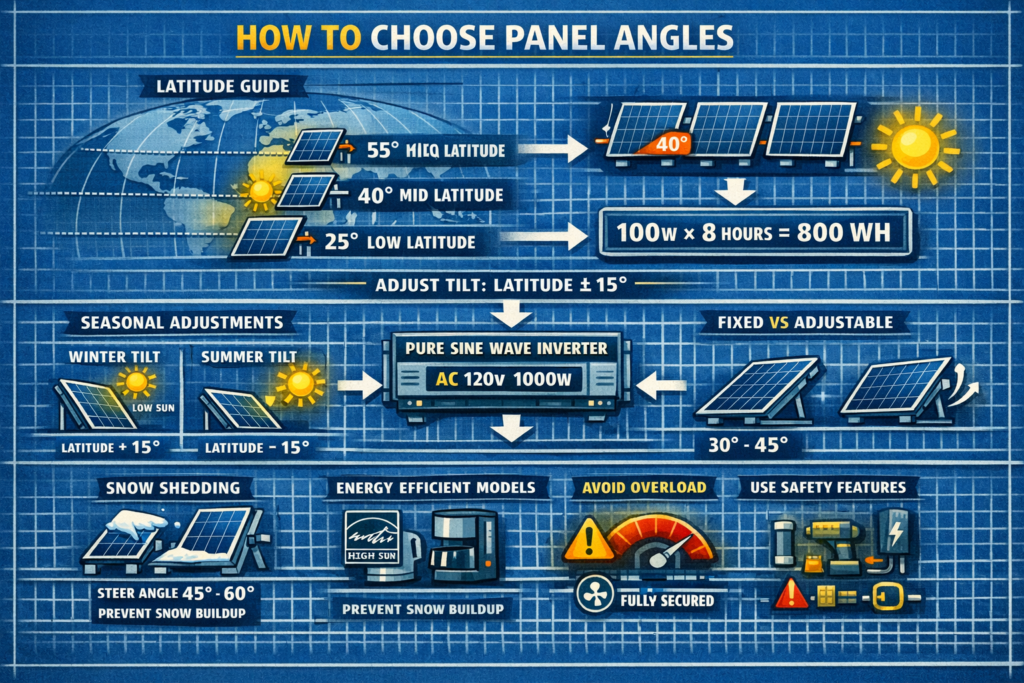
Best Solar Panel Angle by Latitude
As a baseline, set your solar panel angle equal to your latitude.
| Latitude | Recommended Year‑Round Angle |
|---|---|
| 20° | 20° tilt |
| 30° | 30° tilt |
| 40° | 40° tilt |
| 50° | 50° tilt |
This gives a balanced year‑round output.
Seasonal Solar Panel Angles
If you want to optimize for a specific season, use these adjustments:
| Season | Angle Formula | Example at 35° Latitude |
|---|---|---|
| Summer | Latitude − 10° | 25° |
| Spring/Fall | Latitude | 35° |
| Winter | Latitude + 10–15° | 45–50° |
Why? The sun is higher in summer and lower in winter.
Best Angle for Maximum Winter Output
Winter sun is low, so panels should be tilted steeply.
- Latitude + 10–15° for general winter use
- Latitude + 20–25° for heavy winter loads (fridge, heater fans, well pumps)
Steeper angles also help snow slide off.
Best Angle for Maximum Summer Output
Summer sun is high, so panels should be flatter.
- Latitude − 10° for general summer use
- Latitude − 15° for peak summer production
Flatter angles also reduce wind load on portable panels.
Best Angle for Portable Solar Panels
Portable folding panels are easiest to optimize because you can adjust them anytime.
Use this simple rule:
Set the panel angle equal to the sun’s angle above the horizon.
Or use the shadow rule:
- Adjust the panel until its shadow is directly behind it
- No sideways shadow = maximum output
This works anywhere, anytime, without math.
Best Angle for Solar Generators (EcoFlow, Jackery, BLUETTI)
For portable power stations, you want the most energy per day. Use these angles:
| Use Case | Recommended Angle |
|---|---|
| Camping / RV | 30–45° |
| Home backup (year‑round) | Latitude |
| Winter outages | Latitude + 15° |
| Summer AC use | Latitude − 10° |
How to Adjust Angle Without Tools
Use the “shadow method”:
- Place the panel facing the sun
- Adjust tilt until the panel’s shadow is shortest
- Rotate until the shadow is directly behind the panel
This gives near‑perfect alignment.
Common Mistakes When Choosing Panel Angles
- Panels too flat: loses winter production
- Panels too steep: loses summer production
- Ignoring shading: even small shadows kill output
- Not adjusting portable panels: leaving them flat on the ground wastes 20–40%
- Wrong direction: always face true south (not magnetic south)
FAQ: Solar Panel Angles
What angle should solar panels be set at?
Equal to your latitude for year‑round use.
Should solar panels be flat?
No — flat panels lose efficiency and collect dirt.
Do solar panels need to face true south?
Yes — true south gives maximum daily exposure.
How often should I adjust portable panels?
Every 1–2 hours for maximum output, or at least morning/midday/afternoon.
🔆 Explore More Solar Optimization Guides
Dial in your solar generator, panels, and battery bank with our complete set of guides.
As an Amazon Associate, we earn from qualifying purchases. This does not affect our reviews or product recommendations.