How to Calculate Watt‑Hours – Simple Formula & Real Examples
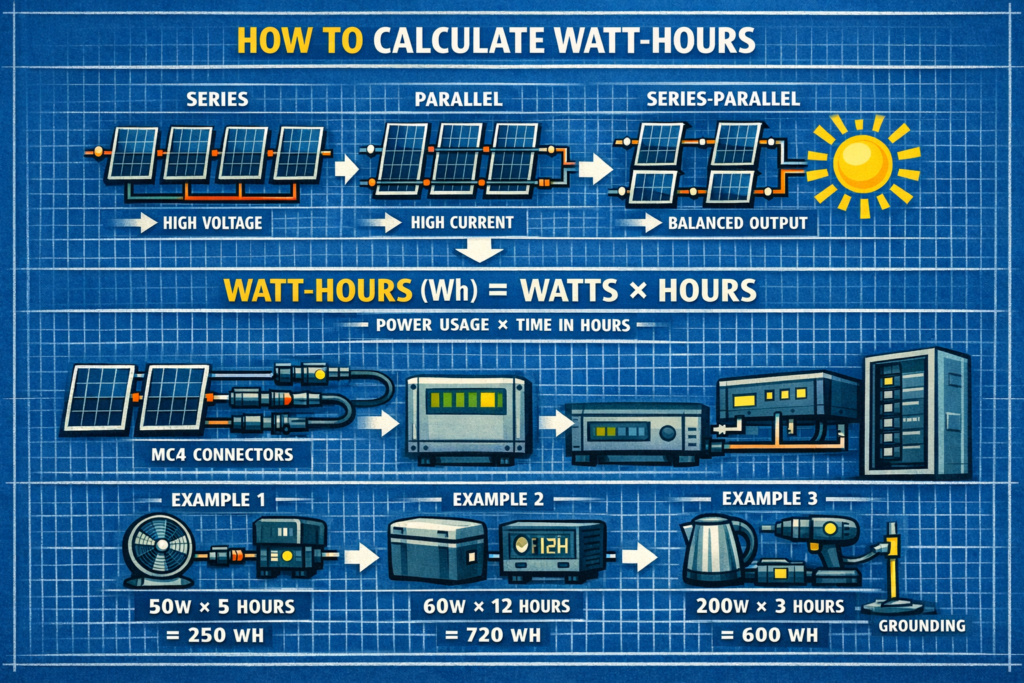
Watt‑hours (Wh) tell you how much energy a device uses over time. If watts measure power, watt‑hours measure energy. This is the number you need when sizing a solar generator, battery bank, or backup power system.
The good news: calculating watt‑hours is extremely simple. You only need two numbers — watts and hours.
The Watt‑Hour Formula
Watt‑Hours (Wh) = Watts (W) × Hours (h)
That’s it. One multiplication gives you the energy used.
Example Calculations
| Device | Watts | Hours | Watt‑Hours (Wh) |
|---|---|---|---|
| LED Light | 10W | 5h | 50Wh |
| Laptop | 60W | 3h | 180Wh |
| Mini Fridge (average) | 60W | 24h (cycling) | 1440Wh |
| CPAP Machine | 40W | 8h | 320Wh |
How to Calculate Daily Energy Use
To size a battery or solar generator, calculate the total daily watt‑hours of everything you want to run.
Example load list:
| Device | Watts | Hours | Daily Wh |
|---|---|---|---|
| Lights | 40W | 5h | 200Wh |
| Laptop | 60W | 4h | 240Wh |
| Router | 15W | 8h | 120Wh |
| Mini Fridge | 60W | 24h | 1440Wh |
| Total Daily Energy | 2000Wh | ||
This home needs about 2000Wh per day.
How to Convert Amp‑Hours (Ah) to Watt‑Hours (Wh)
If your battery is labeled in amp‑hours instead of watt‑hours, use this formula:
Watt‑Hours (Wh) = Amp‑Hours (Ah) × Volts (V)
Example:
- 12V battery
- 100Ah capacity
100Ah × 12V = 1200Wh
A 12V 100Ah battery stores about 1200Wh.
How to Estimate Runtime from Watt‑Hours
Once you know watt‑hours, you can estimate runtime:
Runtime (hours) = Battery Wh ÷ Device Watts
Example:
- Battery: 1000Wh
- Device: 100W
1000Wh ÷ 100W = 10 hours
Real‑world runtime is usually 10–15% lower due to inverter losses.
Watt‑Hour Cheat Sheet
| Device | Daily Wh |
|---|---|
| Phone charging | 20–40Wh |
| LED bulb | 40–80Wh |
| Laptop | 150–300Wh |
| CPAP | 300–500Wh |
| Mini fridge | 800–1500Wh |
| Full‑size fridge | 1000–2000Wh |
Common Mistakes When Calculating Watt‑Hours
- Ignoring inverter losses: subtract 10–15% for AC loads
- Using peak watts instead of average watts: fridges cycle
- Not counting all devices: routers, lights, chargers add up
- Forgetting 24‑hour loads: fridges and routers run all day
FAQ: Watt‑Hours Explained
What’s the difference between watts and watt‑hours
Watts measure power. Watt‑hours measure energy used over time.
How many watt‑hours is 1 kWh
1 kWh = 1000Wh.
How many watt‑hours do I need per day
Most homes need 2000–5000Wh for essentials; off‑grid cabins vary widely.
How do I size a battery using watt‑hours
Multiply your daily Wh by 1.5–2× for comfortable capacity.
⚡ Explore More Power & Solar Guides
Master watt‑hours, solar sizing, and battery planning with our complete set of guides.
As an Amazon Associate, we earn from qualifying purchases. This does not affect our reviews or product recommendations.