How to Calculate Runtime – Battery, UPS & Solar Load Guide
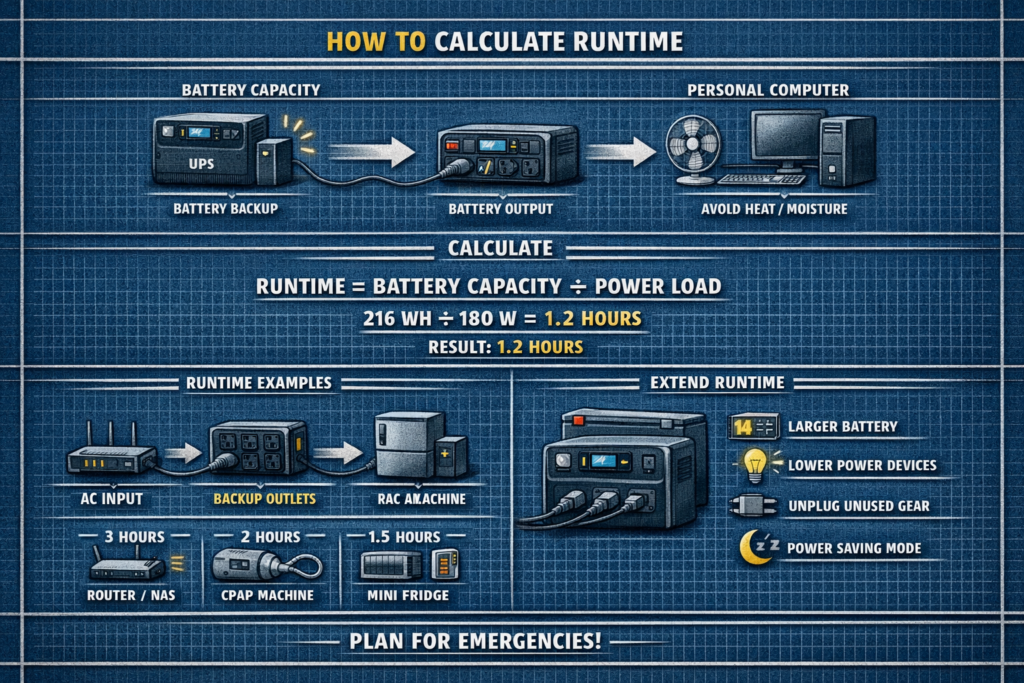
Runtime is simply how long a battery, UPS, or power station can power your devices. Once you know the battery capacity (Wh) and the load (W), the math becomes extremely predictable.
This guide gives you the exact formulas and real‑world examples for UPS units, solar generators, and standalone batteries.
Core Runtime Formula
The universal runtime formula is:
Runtime (hours) = Battery Wh ÷ Load W ÷ Efficiency
Efficiency accounts for inverter losses, heat, and voltage conversion.
- Use 1.1 for power stations
- Use 1.2–1.3 for UPS units
- Use 1.05–1.1 for DC‑only loads (no inverter)
Example: Power Station Runtime
Battery: 1000Wh Load: 200W Efficiency: 1.1
1000Wh ÷ 200W ÷ 1.1 ≈ 4.5 hours
Example: UPS Runtime
UPS batteries are smaller and less efficient than solar generators.
UPS Battery: 300Wh Load: 150W Efficiency: 1.25
300Wh ÷ 150W ÷ 1.25 ≈ 1.6 hours
Most UPS units are designed for 5–20 minutes, not hours.
How to Find Battery Watt‑Hours (Wh)
If the battery only lists volts and amp‑hours:
Wh = Volts × Amp‑Hours
| Battery | Math | Wh |
|---|---|---|
| 12V, 100Ah | 12 × 100 | 1200Wh |
| 24V, 50Ah | 24 × 50 | 1200Wh |
| 48V, 100Ah | 48 × 100 | 4800Wh |
How to Estimate Runtime for Multiple Devices
Add up all device wattages:
| Device | Watts |
|---|---|
| Router | 15W |
| Laptop | 60W |
| Monitor | 30W |
| Total Load | 105W |
Then plug into the formula:
Runtime = Battery Wh ÷ 105W ÷ 1.1
Runtime Table (Quick Estimates)
| Battery Size | 100W Load | 200W Load | 500W Load |
|---|---|---|---|
| 300Wh (UPS) | 2.7h | 1.3h | 0.5h |
| 500Wh | 4.5h | 2.2h | 0.9h |
| 1000Wh | 9h | 4.5h | 1.8h |
| 2000Wh | 18h | 9h | 3.6h |
Assumes 1.1 efficiency factor.
How to Calculate Runtime for Solar Systems
Solar adds energy back into the battery, so runtime becomes:
Net Runtime = Battery Wh ÷ (Load W − Solar W)
If solar input equals or exceeds load, runtime becomes effectively unlimited.
Common Mistakes When Calculating Runtime
- Ignoring inverter losses (always use an efficiency factor)
- Using peak panel watts instead of real solar watts
- Not measuring actual device wattage (labels often overstate)
- Assuming UPS units run for hours (they don’t)
- Forgetting startup surges for fridges, pumps, and compressors
FAQ: Runtime Calculation
How accurate is the runtime formula
Very accurate when you use real wattage and a proper efficiency factor.
Do power stations show runtime estimates
Yes, but they fluctuate—manual calculation is more reliable.
Does battery age reduce runtime
Yes—older batteries lose capacity and shorten runtime.
How do I measure real wattage
Use a Kill A Watt meter or check your power station’s live watt display.
⚡ Explore More Power & Runtime Guides
Pair runtime math with proper sizing, wiring, and battery planning.
As an Amazon Associate, we earn from qualifying purchases. This does not affect our reviews or product recommendations.