
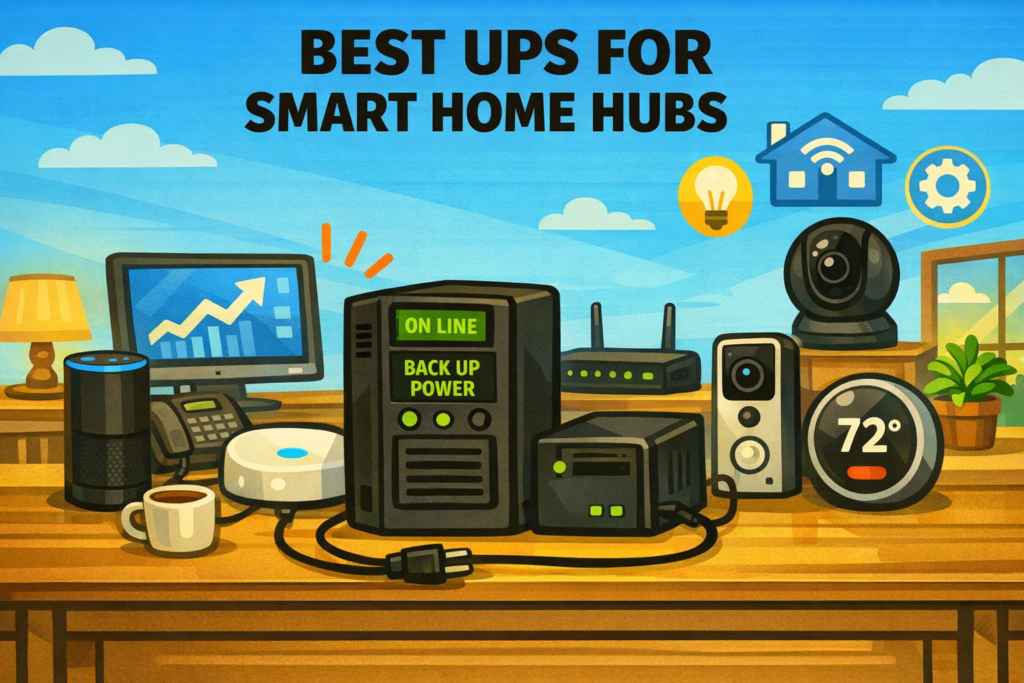
Best UPS for Smart Home Hubs – Reviews – Comparisons – Buyer Insight
Your smart home is only as reliable as the power feeding its brain. When the power drops, hubs reboot, automations fail, voice assistants go offline, and cloud routines stop working. A properly sized UPS keeps your router, smart home hub, and key bridges online so scenes, schedules, and remote access continue during outages.
This guide compares the best UPS units for smart home hubs and control centers. Each recommendation includes capacity, runtime estimates, and protection features so you can match a UPS to your router, hub, and key accessories without overspending.
Best UPS for Smart Home Hubs — Quick Comparison
This comparison table gives you a fast overview of the top UPS options for smart home control setups. It highlights capacity and best‑use scenarios so you can quickly match a unit to your hub and router.
| Model | Best For | Capacity | Output Type | Estimated Runtime* |
|---|---|---|---|---|
| APC BE425M | Single hub + router | 425VA / 255W | Stepped sine | 2–6 hrs @ 10–20W |
| APC BE600M1 | Router + hub + voice assistant | 600VA / 330W | Stepped sine | 3–8 hrs @ 15–30W |
| CyberPower EC850LCD | Multiple hubs + bridges | 850VA / 510W | Simulated sine | 4–10 hrs @ 20–40W |
| APC BR1000MS2 | Smart home + NAS + router | 1000VA / 600W | Pure sine wave | 3–8 hrs @ 40–80W |
| EcoFlow River 2 Max | Extended smart home runtime | 512Wh | Pure sine wave | 10–20 hrs @ 20–30W |
*Runtime varies based on router, hub, and accessory load.
Best UPS for Smart Home Hubs by Scenario
Smart homes range from a single hub and router to full automation stacks with multiple bridges, controllers, and voice assistants. These recommendations cover the most common setups.
APC BE425M
Definition: This category is for simple smart homes with a single hub (like SmartThings, Home Assistant, or Hubitat) and a router.
The APC BE425M provides enough backup power to keep your router and hub online through short and moderate outages.
| Capacity | 425VA / 255W |
|---|---|
| Output Type | Stepped sine wave |
| Outlets | 6 total (4 battery + surge) |
| Best Use | Single hub + router |
Smart Home Runtime: ~2–6 hours at 10–20W (router + hub).
Pros
- Very affordable
- Compact and easy to hide
- Long runtime for low loads
Cons
- Limited outlets
- Not ideal for larger setups
APC BE600M1
Definition: This category is for homes running a smart hub, router, and one or two voice assistants (Alexa, Google Home, HomePod).
The APC BE600M1 offers more outlets and capacity, plus USB charging, making it ideal for slightly larger smart home cores.
| Capacity | 600VA / 330W |
|---|---|
| Output Type | Stepped sine wave |
| Outlets | 7 total (5 battery + surge) |
| Best Use | Router + hub + voice assistant |
Smart Home Runtime: ~3–8 hours at 15–30W.
Pros
- Great balance of size and runtime
- USB port for hubs or speakers
- Compact footprint
Cons
- Not pure sine wave
- Limited for larger automation stacks
CyberPower EC850LCD
Definition: This category is for advanced smart homes with multiple hubs and bridges (Hue, Lutron, Z‑Wave, Zigbee, Thread, Matter, etc.).
The CyberPower EC850LCD provides more outlets and runtime, plus an LCD to monitor load and estimated runtime.
| Capacity | 850VA / 510W |
|---|---|
| Output Type | Simulated sine wave |
| Outlets | 12 total (6 battery + surge) |
| Best Use | Multiple hubs + bridges |
Smart Home Runtime: ~4–10 hours at 20–40W.
Pros
- Lots of outlets for hubs and bridges
- LCD shows load and runtime
- Excellent value for advanced setups
Cons
- Not pure sine wave
- Overkill for very small systems
APC BR1000MS2
Definition: This category is for smart homes that also run a NAS, Home Assistant server, or local automation controller.
The APC BR1000MS2 provides pure sine‑wave power, ideal for NAS and mini‑PC controllers alongside your smart home hub and router.
| Capacity | 1000VA / 600W |
|---|---|
| Output Type | Pure sine wave |
| Outlets | 10 total (6 battery + surge) |
| Best Use | Smart home + NAS + router |
Smart Home Runtime: ~3–8 hours at 40–80W.
Pros
- Pure sine wave for NAS and mini‑PCs
- Plenty of outlets for full cores
- Great for local‑first smart homes
Cons
- More expensive than basic UPS units
- Larger footprint
EcoFlow River 2 Max
Definition: This category is for homes in outage‑prone areas that want their smart home core online for many hours or overnight.
The EcoFlow River 2 Max is a portable power station that can run your router, hub, and bridges for extended periods.
| Capacity | 512Wh |
|---|---|
| Output Type | Pure sine wave |
| Outlets | AC + USB + DC |
| Best Use | Extended smart home runtime |
Smart Home Runtime: ~10–20 hours at 20–30W.
Pros
- Very long runtime for low‑draw systems
- Portable and silent
- Can be recharged via solar
Cons
- More expensive than standard UPS units
- Not a traditional inline UPS
Popular UPS Accessories for Smart Home Hubs
These accessories help you organize, protect, and optimize your smart home power core for smoother automations and safer operation.
Kill A Watt Power Meter
Measure your smart home core’s real‑world wattage so you can size your UPS with confidence.
| Type | Power meter |
|---|---|
| Use Case | Load measurement |
Surge‑Protected Power Strip
Expand your UPS outlets for hubs, bridges, and speakers while keeping them protected.
| Outlets | 6–12 |
|---|---|
| Use Case | Accessory power distribution |
Cable Management Sleeves
Keep UPS, router, and hub cables tidy for better airflow and easier troubleshooting.
| Type | Velcro / zip sleeves |
|---|---|
| Use Case | Media cabinets & network shelves |
Label Maker
Label battery vs. surge outlets and critical smart home power runs so nothing gets unplugged by mistake.
| Type | Label printer |
|---|---|
| Use Case | Smart home and network panels |
How to Choose the Best UPS for Your Smart Home Hub
Choosing the right UPS starts with knowing your core load. Most routers draw 10–20W, hubs 3–10W, and bridges 2–5W each. Add everything together, then choose a UPS that can handle at least 2× your typical draw so you get long runtime and room to grow.
| Smart Home Core Type | Typical Draw | Recommended UPS Size |
|---|---|---|
| Router + single hub | 10–20W | 400–600VA |
| Router + hub + voice assistant | 15–30W | 600–850VA |
| Multiple hubs + bridges | 20–40W | 850–1000VA |
| Smart home + NAS / controller | 40–80W | 1000VA+ |
People Also Ask (Quick Answers)
Do I need a UPS for my smart home hub
If you rely on automations, remote access, or cloud routines, a UPS keeps your smart home brain online during outages.
How long should a UPS run my smart home hub
Most users aim for 2–10 hours of runtime for router + hub + key bridges.
Can I plug my smart speakers into the UPS
Yes—just remember they add to total load and reduce runtime slightly.
Do smart home hubs need pure sine wave
Most hubs and routers work fine on simulated sine wave, but pure sine is a nice bonus if you also power a NAS or mini‑PC.
Real‑World UPS Runtime Examples for Smart Home Hubs
These examples show how long common UPS sizes can keep a typical smart home core running. Actual runtime depends on router, hub, and accessory load.
| UPS Size | Smart Home Load | Approx. Runtime |
|---|---|---|
| 425VA / 255W | 10–20W | 2–6 hours |
| 600VA / 330W | 15–30W | 3–8 hours |
| 850VA / 510W | 20–40W | 4–10 hours |
| 1000VA / 600W | 40–80W | 3–8 hours |
| 500Wh power station | 20–30W | 10–20 hours |
Common Mistakes When Choosing a UPS for Smart Home Hubs
- Not backing up the router: Hubs lose cloud access without internet.
- Using surge‑only outlets: Many UPS units have both battery and surge‑only ports—double‑check labels.
- Underestimating bridge count: Hue, Lutron, and other bridges add up.
- Not testing failover: Always simulate an outage once to confirm everything stays online.
- Letting UPS batteries age out: Replace batteries every few years.
FAQ: UPS for Smart Home Hubs
Can I use a computer UPS for my smart home
Yes—most smart homes run perfectly on PC‑class UPS units.
Will a UPS keep my smart locks and sensors working
Battery‑powered devices keep working; the UPS keeps the hub and router online so automations still run.
Should I leave my UPS on all the time
Yes—UPS units are designed to stay on and ready.
🏠 Explore More Smart Home Power Guides
Protect your smart home hubs, routers, and automation cores with our full collection of backup power guides.
As an Amazon Associate, we earn from qualifying purchases. This does not affect our reviews or product recommendations.