Best Direction to Face Solar Panels
The direction your solar panels face has a huge impact on how much energy they produce. Get it right, and you can gain 10–30% more power without adding a single extra panel.
This guide explains the best direction to face solar panels for maximum daily energy, morning vs afternoon power, and portable solar generators.
Solar Panel Direction Basics
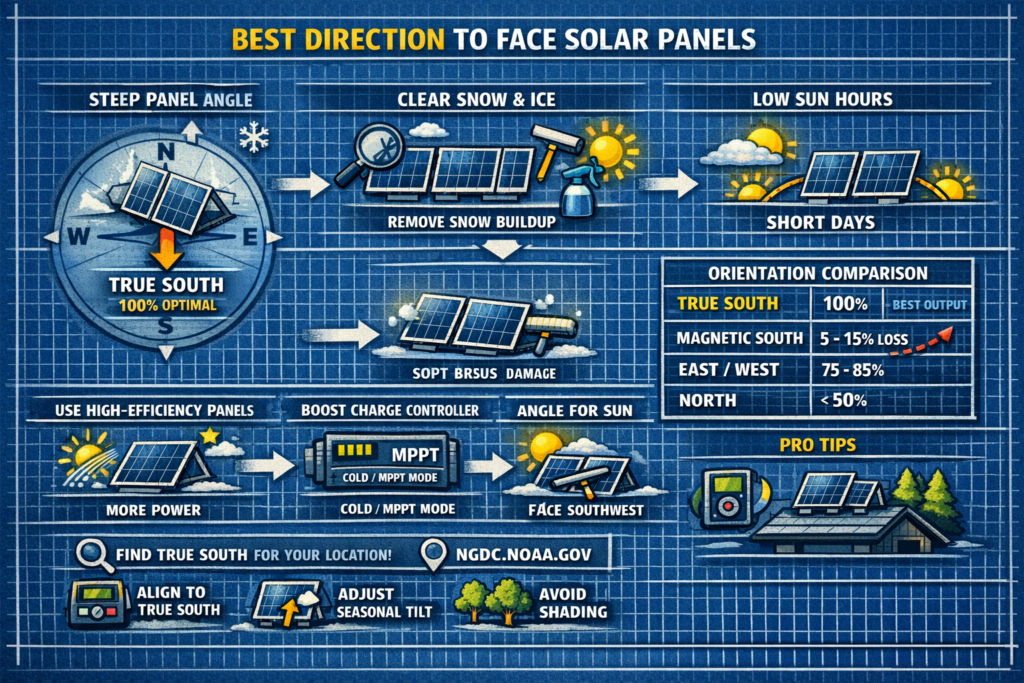
Solar panels produce the most energy when they face the sun for as many hours as possible. Because the sun moves east to west and tilts toward the equator, the best direction depends on which hemisphere you’re in.
- Northern hemisphere: best direction is true south
- Southern hemisphere: best direction is true north
“True” south/north is slightly different from what a magnetic compass shows—more on that below.
Best Direction by Hemisphere
| Location | Best Direction | Why |
|---|---|---|
| Northern hemisphere (US, Europe, etc.) | True south | Maximizes sun exposure all day |
| Southern hemisphere (Australia, parts of South America, etc.) | True north | Maximizes sun exposure all day |
| Near the equator | East, west, or slightly north/south | Sun is high and nearly overhead |
True South vs Magnetic South
Compasses point to magnetic south, not true south. The difference is called magnetic declination and varies by location.
- In many parts of the US, magnetic south can be off by 5–20° from true south
- For rooftop systems, this small error usually isn’t critical
- For ground mounts or large arrays, using true south is ideal
You can approximate true south by:
- Using a smartphone compass app with “true north” enabled
- Noting the sun’s position at solar noon and aligning perpendicular to its path
East vs West vs South: What Changes?
Sometimes you can’t face panels perfectly south or north. In that case, you choose based on when you need power most.
| Direction | Pros | Cons |
|---|---|---|
| South (north in southern hemisphere) | Highest total daily energy; best for overall production | Less focused on morning or late afternoon peaks |
| South‑east / East | More power in the morning; good for early loads | Less power late afternoon; slightly lower total energy |
| South‑west / West | More power in late afternoon; good for evening AC loads | Less power in the morning; slightly lower total energy |
For most home and off‑grid systems, south‑facing wins unless you have a specific reason to favor morning or afternoon power.
Best Direction for Portable Solar Panels & Generators
Portable panels are easy—you can always point them directly at the sun.
- In the northern hemisphere, aim generally south and then fine‑tune
- In the southern hemisphere, aim generally north and fine‑tune
- Use the shadow trick: rotate the panel until its shadow is directly behind it
Re‑aiming portable panels 2–3 times per day (morning, midday, afternoon) can boost energy harvest by 20–40% compared to leaving them fixed.
When It’s Okay Not to Face Perfectly South
Real roofs and sites aren’t perfect. You might have to compromise on direction because of:
- Roof orientation (east‑west roofs)
- Shading from trees, chimneys, or nearby buildings
- Aesthetics or structural constraints
Good news: panels facing within about 30° of south (or north in the southern hemisphere) still perform very well. A slight east or west bias usually only costs a small percentage of total energy.
Direction vs Tilt: Which Matters More?
Both matter, but direction is usually the first priority:
- Direction: determines how many hours per day the sun hits the panels
- Tilt: fine‑tunes how directly the sun hits the panels
Rule of thumb:
- Get direction roughly right (south/north) first
- Then optimize tilt to match your latitude and season
Common Mistakes with Solar Panel Direction
- Facing panels east or west when south is available: leaves energy on the table
- Using magnetic south instead of true south: small but avoidable loss
- Ignoring shading: a perfectly south‑facing but shaded array can underperform a slightly off‑axis but unshaded one
- Not adjusting portable panels: leaving them flat or randomly oriented wastes potential
FAQ: Best Direction to Face Solar Panels
What is the best direction to face solar panels in the US?
True south is best for maximum yearly energy production.
Is west‑facing solar worth it?
Yes, especially if your main loads are in the late afternoon and evening—but total energy will be slightly lower than south‑facing.
Can I mix panel directions on one system?
Yes, but it’s best to keep strings or MPPT inputs grouped by direction (all south on one input, all west on another).
Does direction matter for portable solar generators?
Yes—but you can easily adjust them. Aim toward the sun and keep the panel’s shadow directly behind it for best results.
🔆 Explore More Solar Optimization Guides
Pair the right direction with smart angles, clean glass, and good wiring to squeeze every watt from your panels.
As an Amazon Associate, we earn from qualifying purchases. This does not affect our reviews or product recommendations.