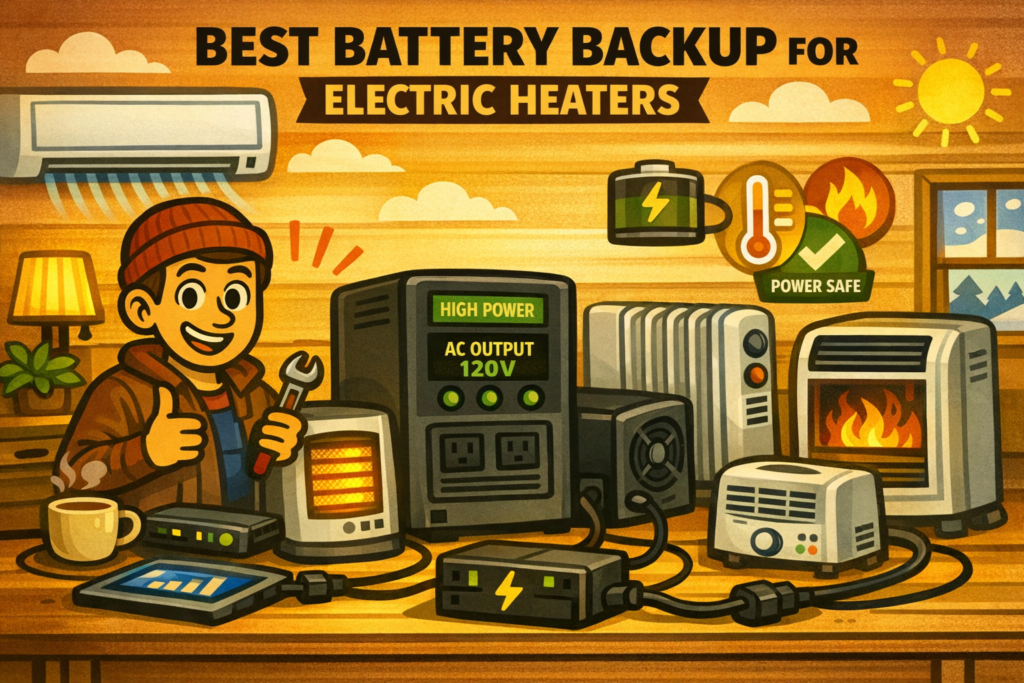
Best Battery Backup for Electric Heaters – Reviews – Comparisons – Buyer Insight
When the power fails in cold weather, staying warm becomes a safety issue, not just a comfort upgrade. Electric space heaters draw a lot of power—often 1000–1500W—so standard desktop UPS units are not designed to run them for long. High‑capacity battery power stations and inverter generators are the realistic way to keep electric heaters running during outages.
This guide compares the best battery backup options for electric heaters, focusing on continuous wattage, surge capability, and realistic runtime. Each recommendation includes capacity, heater compatibility, and best‑use scenarios so you can match a battery system to your heating load without guesswork.
Best Battery Backup for Electric Heaters — Quick Comparison
This comparison table gives you a fast overview of the top battery backup options for electric heaters. It highlights capacity, output, and best‑use scenarios so you can quickly match a unit to your heater type.
| Model | Best For | Capacity | Output / Surge | Estimated Runtime* |
|---|---|---|---|---|
| EcoFlow DELTA 2 | Low‑watt heaters & partial power | 1024Wh | 1800W / 2700W surge | 30–60 min @ 1000–1200W |
| Jackery Explorer 2000 Plus | 1500W space heaters | 2042Wh | 3000W / surge capable | 60–90 min @ 1300–1500W |
| BLUETTI AC200MAX | Radiant & oil‑filled heaters | 2048Wh | 2200W / 4800W surge | 60–90 min @ 1200–1500W |
| EcoFlow DELTA Pro | Multiple heaters / longer runtime | 3600Wh | 3600W / 7200W surge | 90–150 min @ 1500–2000W |
| Honda EU2200i | All‑day heater runtime | Gas inverter generator | 1800W / 2200W surge | 5–9 hrs @ 1000–1500W (per tank) |
*Runtime estimates assume typical 1000–1500W heater loads; actual runtime depends on heater setting and duty cycle.
Best Battery Backup for Electric Heaters by Scenario
Electric heaters vary from low‑wattage radiant panels to full‑power 1500W ceramic or oil‑filled units. These recommendations cover the most common heating setups during outages.
EcoFlow DELTA 2
Definition: This category is for 500–1000W heaters, or running a 1500W heater on a lower setting to stretch runtime.
The EcoFlow DELTA 2 delivers 1024Wh of LiFePO₄ storage with 1800W pure sine‑wave output, making it a solid match for modest heater loads and short‑term warmth.
| Capacity | 1024Wh |
|---|---|
| Output | 1800W (2700W surge) |
| Best Use | Low‑watt heaters & reduced‑power settings |
| Ports | AC, USB, DC |
Heater Runtime: ~30–60 minutes at 1000–1200W, longer if you run at 500–750W.
Pros
- LiFePO₄ battery for long cycle life
- Fast AC and solar charging
- Good fit for “spot heating” in one room
Cons
- Short runtime at full 1500W heater power
- Not ideal for multi‑hour whole‑room heating
Jackery Explorer 2000 Plus
Definition: This category is for standard 1500W ceramic, fan, or oil‑filled space heaters used in bedrooms, living rooms, or offices.
The Jackery Explorer 2000 Plus offers over 2kWh of capacity with 3000W output, giving enough headroom for a full‑power 1500W heater and roughly an hour or more of runtime.
| Capacity | 2042Wh |
|---|---|
| Output | 3000W (high surge capability) |
| Best Use | Full‑power 1500W space heaters |
| Expandability | Supports extra battery packs |
Heater Runtime: ~60–90 minutes at 1300–1500W, longer if you cycle the heater or lower the setting.
Pros
- High output for full‑size heaters
- Expandable capacity for longer warmth
- Clean, quiet indoor operation
Cons
- Expensive compared to smaller units
- Still limited runtime for all‑night heating
BLUETTI AC200MAX
Definition: This category is for efficient radiant panels and oil‑filled radiators that often run at 800–1500W but can be throttled down for longer runtime.
The BLUETTI AC200MAX delivers 2048Wh of LiFePO₄ storage with 2200W output and 4800W surge, making it a strong match for steady heater loads.
| Capacity | 2048Wh |
|---|---|
| Output | 2200W (4800W surge) |
| Best Use | Radiant & oil‑filled heaters |
| Expandability | Supports extra battery modules |
Heater Runtime: ~60–90 minutes at 1200–1500W, or 2–3 hours at 600–800W.
Pros
- LiFePO₄ chemistry for long life
- Great for steady, non‑surging heater loads
- Expandable for longer outages
Cons
- Heavy and best used semi‑stationary
- Upfront cost is significant
EcoFlow DELTA Pro
Definition: This category is for running one or two heaters, or combining a heater with other essential loads, for longer periods.
The EcoFlow DELTA Pro packs 3600Wh of capacity with 3600W output and 7200W surge, and can integrate with home transfer switches for more advanced backup setups.
| Capacity | 3600Wh |
|---|---|
| Output | 3600W (7200W surge) |
| Best Use | Multiple heaters / heater + other loads |
| Expandability | Expandable with extra batteries & smart panel |
Heater Runtime: ~90–150 minutes at 1500–2000W combined load; longer if you cycle heaters or run at reduced power.
Pros
- Very high output and capacity
- Home integration options
- Can share power between heat and other essentials
Cons
- High upfront cost
- Still not an “all‑night” heater solution without expansion
Honda EU2200i
Definition: This category is for users who need many hours of heater runtime during extended outages and are comfortable with a fuel‑powered solution.
The Honda EU2200i is a quiet inverter generator that can run a 1000–1500W heater for long periods with proper ventilation and load management.
| Type | Gas inverter generator |
|---|---|
| Output | 1800W continuous / 2200W surge |
| Best Use | All‑day heater runtime |
| Runtime | 5–9 hours @ 1000–1500W per tank (eco mode) |
Heater Runtime: Multi‑hour or all‑day potential with refueling and safe outdoor operation.
Pros
- Much longer runtime than batteries alone
- Proven reliability and quiet operation
- Can power other household loads
Cons
- Requires fuel and outdoor use
- Not silent or fully “indoor‑only” like batteries
Popular Accessories for Electric Heater Battery Backup
These accessories help you connect, monitor, and optimize your electric heater battery backup setup safely.
Low‑Watt Electric Heater
Using a 400–800W heater instead of a 1500W unit can dramatically extend battery runtime.
| Type | Low‑watt radiant / panel heater |
|---|---|
| Use Case | Targeted heating on battery power |
Heavy‑Duty Extension Cord
Use a properly rated cord between your battery system and heater to handle high current safely.
| Gauge | 12‑gauge or better |
|---|---|
| Use Case | High‑draw heater loads |
Kill A Watt Power Meter
Measure your heater’s real‑world wattage so you can size your battery backup correctly.
| Type | Plug‑in power meter |
|---|---|
| Use Case | Load measurement |
Thermal Blankets & Draft Stoppers
Reducing heat loss with insulation and draft control lets your heater run less and your battery last longer.
| Type | Blankets, draft stoppers |
|---|---|
| Use Case | Efficiency during outages |
How to Choose the Best Battery Backup for Your Electric Heater
Choosing the right battery backup starts with knowing your heater’s wattage. Many portable electric heaters draw 1500W on high, 750–1000W on low, and some radiant panels run at 400–800W. Battery capacity in watt‑hours divided by heater wattage gives a rough runtime estimate—then subtract 10–20% for inverter losses.
| Heater Type | Typical Draw | Recommended Battery Size |
|---|---|---|
| Low‑watt panel / radiant heater | 400–800W | 1–2kWh power station (1800W+ output) |
| Standard 1500W space heater | 1200–1500W | 2kWh+ power station (2200–3000W output) |
| Multiple heaters / heater + other loads | 1500–2500W+ | 3kWh+ system or inverter generator |
People Also Ask (Quick Answers)
Can a UPS run an electric heater
Standard desktop UPS units are not designed for 1000–1500W heater loads and will drain in minutes or overload. High‑output battery power stations or generators are required.
How big of a battery do I need to run a 1500W heater
A 2kWh battery gives roughly 60–90 minutes at full power; larger 3kWh+ systems extend that to 1.5–2.5 hours.
Can I run an electric heater all night on battery
Most consumer battery stations cannot run a 1500W heater all night without very large capacity or supplemental generator/solar support.
Is a generator better than a battery for heaters
For long runtimes, inverter generators are more practical; batteries excel at short, quiet, indoor‑friendly heating windows.
Real‑World Battery Runtime Examples for Electric Heaters
These examples show how long common battery sizes can keep a typical electric heater running. Actual runtime depends on heater setting, cycling, and ambient temperature.
| Battery Size | Heater Load | Approx. Runtime |
|---|---|---|
| 1000Wh | 800–1000W | 35–60 minutes |
| 2000Wh | 1200–1500W | 60–90 minutes |
| 3600Wh | 1500–2000W | 90–150 minutes |
Common Mistakes When Choosing Battery Backup for Electric Heaters
- Using a standard UPS: Most UPS units are not rated for continuous 1500W heater loads.
- Ignoring wattage: Heaters are among the highest‑draw household devices—always check the label.
- Expecting all‑night runtime from small batteries: 1–2kWh batteries are for short windows of heat, not full‑night heating.
- Using undersized extension cords: High current demands proper gauge wiring.
- Not combining with insulation: Draft control and blankets reduce how hard your heater needs to work.
FAQ: Battery Backup for Electric Heaters
Can I plug my heater directly into a power station
Yes—if the power station’s continuous watt rating exceeds the heater’s draw. Always verify the numbers first.
Is propane or kerosene safer than electric on battery
Combustion heaters require strict ventilation and safety precautions; electric heaters on battery avoid fumes but demand large electrical capacity.
Should I leave my battery power station plugged in
Most are designed to stay plugged in and ready, but always follow the manufacturer’s guidance.
🔥 Explore More Heating & Backup Power Guides
Pair your electric heaters with the right backup power system using our full collection of outage‑ready guides.
As an Amazon Associate, we earn from qualifying purchases. This does not affect our reviews or product recommendations.