Best Battery Backup for Air Conditioners – Reviews – Comparisons – Buyer Insight
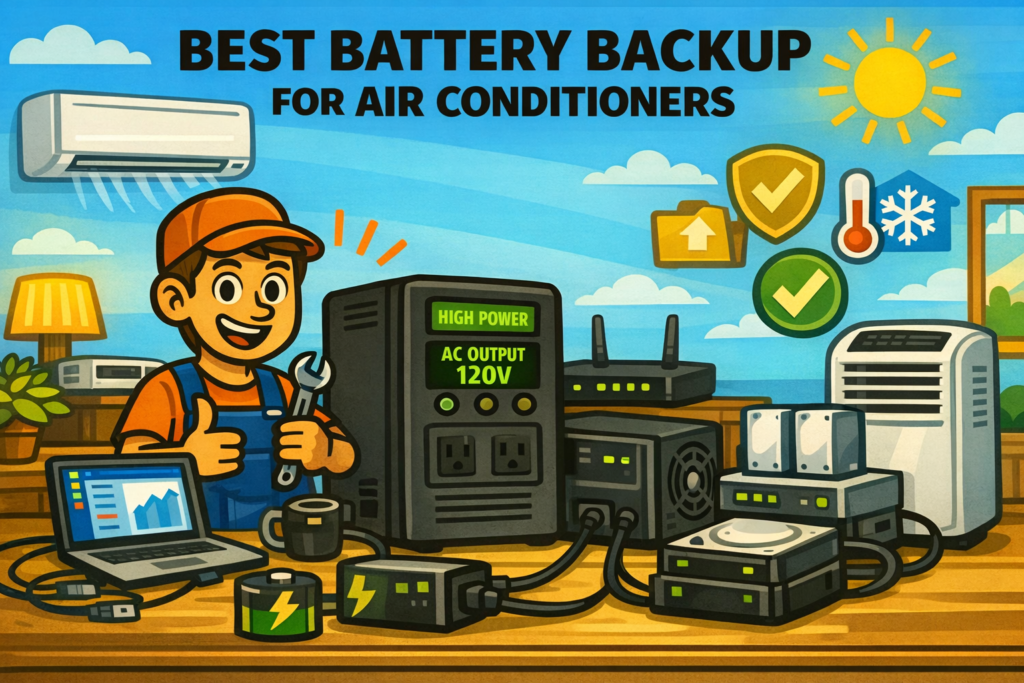
When the power goes out in the middle of a heat wave, air conditioning is more than comfort—it can be a safety issue. Standard UPS units are not designed to start compressors, but high‑capacity battery power stations and inverter generators can keep window ACs, mini‑splits, and portable units running through outages.
This guide compares the best battery backup options for air conditioners, focusing on surge power, continuous wattage, and realistic runtime. Each recommendation includes capacity, AC compatibility, and best‑use scenarios so you can match a battery system to your cooling load without guesswork.
Best Battery Backup for Air Conditioners — Quick Comparison
This comparison table gives you a fast overview of the top battery backup options for air conditioners. It highlights capacity, output, and best‑use scenarios so you can quickly match a unit to your AC type.
| Model | Best For | Capacity | Output / Surge | Estimated Runtime* |
|---|---|---|---|---|
| EcoFlow DELTA 2 | Small window / portable AC | 1024Wh | 1800W / 2700W surge | 45–90 min @ 700–900W |
| Jackery Explorer 2000 Plus | Longer runtime cooling | 2042Wh | 3000W / surge capable | 1.5–3 hrs @ 700–900W |
| BLUETTI AC200MAX | Mini‑split & RV AC | 2048Wh | 2200W / 4800W surge | 1.5–3 hrs @ 700–1000W |
| EcoFlow DELTA Pro | Whole‑room / multiple ACs | 3600Wh | 3600W / 7200W surge | 2–5 hrs @ 800–1500W |
| Honda EU2200i | Extended AC runtime | Gas inverter generator | 1800W / 2200W surge | 5–9 hrs @ 800–1200W (per tank) |
*Runtime estimates assume typical small AC loads; actual runtime depends on BTU rating, duty cycle, and fan/compressor behavior.
Best Battery Backup for Air Conditioners by Scenario
Air conditioners vary widely in power draw. A 5,000–8,000 BTU window unit is very different from a 12,000 BTU portable AC or a 18,000 BTU mini‑split. These recommendations cover the most common cooling setups.
EcoFlow DELTA 2
Definition: This category is for 5,000–8,000 BTU window ACs and small portable units in bedrooms or home offices.
The EcoFlow DELTA 2 delivers 1024Wh of LiFePO₄ storage with 1800W pure sine‑wave output and strong surge handling, making it a great match for small AC compressors.
| Capacity | 1024Wh |
|---|---|
| Output | 1800W (2700W surge) |
| Best Use | Small window / portable AC |
| Ports | AC, USB, DC |
AC Runtime: ~45–90 minutes at 700–900W average draw (compressor cycling).
Pros
- Fast AC and solar charging
- LiFePO₄ battery for long cycle life
- Strong surge for compressor startup
Cons
- Limited runtime for larger AC units
- Heavier than smaller power stations
Jackery Explorer 2000 Plus
Definition: This category is for users who want 1.5–3 hours of runtime on a small window or portable AC during outages.
The Jackery Explorer 2000 Plus offers over 2kWh of capacity with 3000W output, giving more headroom for startup surges and longer cooling windows.
| Capacity | 2042Wh |
|---|---|
| Output | 3000W (high surge capability) |
| Best Use | Extended runtime for small AC |
| Expandability | Supports extra battery packs |
AC Runtime: ~1.5–3 hours at 700–900W average draw.
Pros
- Large capacity for longer cooling
- High output for demanding loads
- Expandable with extra batteries
Cons
- More expensive than 1kWh units
- Heavy and bulkier to move
BLUETTI AC200MAX
Definition: This category is for efficient mini‑split systems and RV air conditioners with soft‑start kits or inverter compressors.
The BLUETTI AC200MAX delivers 2048Wh of LiFePO₄ storage with 2200W output and up to 4800W surge, making it suitable for many inverter‑type AC systems.
| Capacity | 2048Wh |
|---|---|
| Output | 2200W (4800W surge) |
| Best Use | Mini‑split & RV AC (with soft start) |
| Expandability | Supports extra battery modules |
AC Runtime: ~1.5–3 hours at 700–1000W average draw, depending on SEER rating and duty cycle.
Pros
- High surge capacity for compressor startup
- LiFePO₄ chemistry for long life
- Expandable for longer runtime
Cons
- Requires careful load planning
- Heavy and not very portable indoors
EcoFlow DELTA Pro
Definition: This category is for users who want to run one larger AC or multiple smaller units for several hours.
The EcoFlow DELTA Pro packs 3600Wh of capacity with 3600W output and 7200W surge, and can integrate into home transfer switches for more advanced setups.
| Capacity | 3600Wh |
|---|---|
| Output | 3600W (7200W surge) |
| Best Use | Whole‑room / multiple ACs |
| Expandability | Expandable with extra batteries & smart panel |
AC Runtime: ~2–5 hours at 800–1500W combined load.
Pros
- Very high output and surge capacity
- Large battery for extended cooling
- Home integration options
Cons
- Expensive
- Heavy and best used semi‑stationary
Honda EU2200i
Definition: This category is for users who need many hours of AC runtime during extended outages and are comfortable with a fuel‑powered solution.
The Honda EU2200i is a quiet inverter generator that can run many small AC units or a single larger unit for long periods with proper load management.
| Type | Gas inverter generator |
|---|---|
| Output | 1800W continuous / 2200W surge |
| Best Use | Extended AC runtime |
| Runtime | 5–9 hours @ 800–1200W per tank (eco mode) |
AC Runtime: All‑day potential with refueling and proper ventilation.
Pros
- Much longer runtime than batteries alone
- Proven reliability and quiet operation
- Can power other household loads
Cons
- Requires fuel and outdoor operation
- Not silent or fully “indoor‑safe” like batteries
Popular Accessories for Air Conditioner Battery Backup
These accessories help you connect, monitor, and optimize your AC battery backup setup safely.
Soft‑Start Kit for AC Compressors
Reduces startup surge so your battery power station or inverter generator can start the AC more reliably.
| Type | Soft‑start module |
|---|---|
| Use Case | Window, RV, and mini‑split ACs |
Heavy‑Duty Extension Cord
Use a properly rated cord between your battery system and AC to handle high current safely.
| Gauge | 12‑gauge or better |
|---|---|
| Use Case | High‑draw AC loads |
Kill A Watt Power Meter
Measure your AC’s real‑world wattage and surge behavior so you can size your battery backup correctly.
| Type | Plug‑in power meter |
|---|---|
| Use Case | Load measurement |
Solar Panel Kit for Power Stations
Recharge your battery backup during the day to extend AC runtime during multi‑day outages.
| Type | Foldable or rigid solar panels |
|---|---|
| Use Case | Off‑grid and outage‑prone areas |
How to Choose the Best Battery Backup for Your Air Conditioner
Choosing the right battery backup starts with knowing your AC’s running wattage and surge (startup) wattage. Many 5,000–8,000 BTU window units draw 500–900W running, with 2–3× that briefly at startup. Portable ACs and mini‑splits can draw more. Always size for both continuous draw and surge.
| AC Type | Typical Running Draw | Recommended Battery Size |
|---|---|---|
| 5,000–8,000 BTU window AC | 500–900W | 1–2kWh power station (1800W+ output) |
| 10,000–12,000 BTU portable AC | 800–1200W | 2kWh+ power station (2200–3000W output) |
| Mini‑split (inverter type) | 500–1000W | 2kWh+ power station with high surge |
| Multiple small AC units | 800–1500W+ | 3kWh+ system or inverter generator |
People Also Ask (Quick Answers)
Can a UPS run an air conditioner
Standard desktop UPS units are not designed for AC compressors. You need a high‑output battery power station or inverter generator with enough surge capacity.
How big of a battery do I need to run an AC
For a small window AC, 1–2kWh gives roughly 1–3 hours of runtime depending on load and duty cycle.
Do I need a soft‑start kit
Soft‑start kits help reduce compressor surge and make it easier for battery systems to start AC units reliably.
Can I run central air on a battery backup
Most central AC systems draw too much power for typical consumer battery stations; they usually require whole‑home backup solutions and professional design.
Real‑World Battery Runtime Examples for Air Conditioners
These examples show how long common battery sizes can keep a typical air conditioner running. Actual runtime depends heavily on BTU rating, thermostat setting, and compressor duty cycle.
| Battery Size | AC Load | Approx. Runtime |
|---|---|---|
| 1000Wh | 700W window AC | 45–75 minutes |
| 2000Wh | 800–900W portable AC | 1.5–3 hours |
| 3600Wh | 1000–1500W mixed AC load | 2–5 hours |
Common Mistakes When Choosing Battery Backup for Air Conditioners
- Using a standard UPS: Most UPS units are not rated for AC compressor surge.
- Ignoring surge wattage: Startup draw can be 2–3× running wattage.
- Underestimating runtime needs: Cooling for 30 minutes vs. 3 hours requires very different battery sizes.
- Using undersized extension cords: High current demands proper gauge wiring.
- Not testing under load: Always test your AC with the battery system before you need it.
FAQ: Battery Backup for Air Conditioners
Can I run my AC all night on battery
Most consumer battery stations cannot run AC all night without very large capacity or solar/generator support.
Is a generator better than a battery for AC
For long runtimes, inverter generators are more practical; batteries excel at short, silent, indoor‑friendly cooling windows.
Should I leave my battery power station plugged in
Most are designed to stay plugged in and ready, but always follow the manufacturer’s guidance.
❄️ Explore More Cooling & Backup Power Guides
Pair your air conditioner with the right backup power system using our full collection of outage‑ready guides.
As an Amazon Associate, we earn from qualifying purchases. This does not affect our reviews or product recommendations.